The Last Time
When Knowing Makes the Difference
Most of the time, we do not know when something is happening for the last time.
We finish a conversation, close a door, drive a familiar road, or share an ordinary evening with someone we love, without realizing that a quiet boundary has just been crossed. Only later do we understand that there will be no next time. Memory reaches backward and marks an ordinary moment as an ending, but by then we can no longer enter it with the awareness it deserved.
Occasionally, though, life tells us in advance.
Of course, it is not only last times that deserve this kind of attention. There are also only times: occasions that are not necessarily endings, but that are nevertheless unique and unrepeatable. Both confront us with a kind of scarcity that is easy to overlook in the ordinary course of life.
Knowing this in advance can change more than how we experience these moments. It can change what we choose to do, how we allocate our time and resources, and the attention we give to what is happening around us. It also creates the possibility of experiencing something meaningful across a much longer period than the event itself: through anticipation beforehand, presence in the moment, and reflection afterward.
I have been thinking about this a great deal lately, in part because 2026 has given me an unusual amount of practice.
A Year of Last Times and Only Times
This year, my father passed away. My wife's father passed away as well. Those losses alone would have made 2026 a year of reflection on time, endings, and the transitions between one chapter of life and the next.
But the year has also brought a remarkable concentration of milestones. I turned 50, as did my wife. Our oldest daughter turned 18 and graduated from high school, while our younger daughter turned 16. My wife and I celebrated our twentieth wedding anniversary. And then our older daughter left home to begin university in Nice, France, marking the beginning of an entirely new chapter for her, and for us.
Some of these occasions were joyful, some deeply painful, and others contained elements of both. Yet across this collection of experiences, I have found myself returning to the same observation: each represented a moment of unusual significance, and in many cases I had the advantage of being able to recognize that significance before the moment arrived.
I do not mean anticipation necessarily in the sense of looking forward to something. There is nothing to look forward to in losing someone you love. Rather, I mean the recognition that something important is approaching, that an experience will be scarce or unrepeatable, and that this knowledge ought to influence how we approach it.
Sometimes this means arranging a celebration or making room for a family gathering. Sometimes it means protecting time for a difficult conversation, or simply being present with someone during a period of uncertainty. Not every meaningful moment is one we wish to savor. Some experiences ask nothing more of us than to sit with them, to acknowledge their gravity, and to resist the temptation to look away.
What these occasions have in common is that they deserve an appropriate place in the timeline of our lives, not only while they are happening, but before and afterward as well.
The House in Columbus
That awareness became particularly acute during a recent month in Columbus, Ohio, when I was helping my mother transition to a new home and preparing my childhood home for sale.
After my father's passing, there was plenty to do: organizing Mom's finances, arranging the support she would need, preparing the house, and sorting through decades of accumulated possessions. But beneath the practical work was the awareness that a chapter of my own life was closing.
My family moved into that house when I was in my early teens, and for nearly four decades it remained the place I returned to in the United States. Whenever I brought my own family home, that was where we stayed.
The house itself carried generations of family history. My grandfather built many things inside it. Wooden beams from a barn that had belonged to my mother's family for generations were incorporated into its structure. My mother stenciled the floors. My father and I painted some of the ceilings. The work of our family was quite literally built into the place.
As my departure approached, I became increasingly conscious of the ordinary things I was doing for the last time. These were familiar experiences that had been repeated over decades, but which I now knew would never happen again.
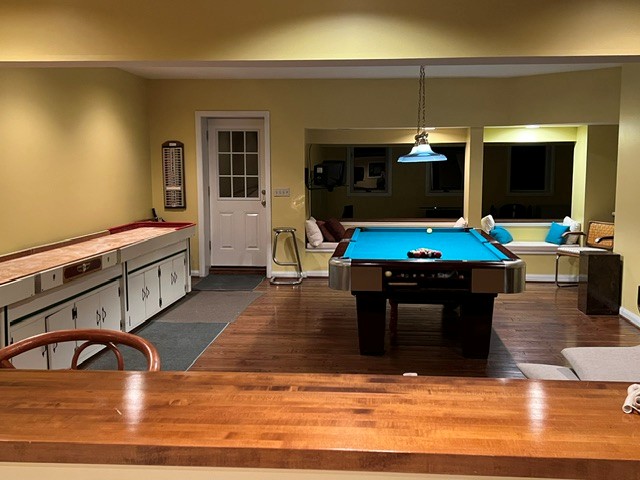
On my final evening, I played one last game of pool on the table where I had learned the game and where I had played so often with my dad. I knew it would be my last game before I began, and that awareness changed how I experienced something I had done hundreds of times before.
I thought about the many games my father and I had played together, and how, somewhere along the way, we had played our final game without knowing it. That moment had become a last time only in retrospect, when there was no longer anything I could do to experience it differently. This occasion was different because I knew in advance what it represented.
The following morning, I woke in my bed there for the last time. I looked into my father's home office and the bedrooms where my brothers had grown up. I walked through familiar spaces, taking in details I had known for decades, with the awareness that I would never see them again.
Finally, it was time to leave. As I walked out of the house, I anticipated the familiar click of the door closing behind me. It was a sound I had known since I was a teenager, one I would recognize anywhere. I waited for it, knowing I would hear it just once more. And when it came, I stood there for a moment, realizing I had just heard that sound for the last time.
Then I drove away.
The next time I visit Columbus, I will stay in a hotel.

When Scarcity Changes the Calculation
My wife and children had their own relationships with the house. For my daughters, it was the place of Christmas, the large family home where everyone gathered year after year. I wanted them to have the opportunity to return and say goodbye, knowing it would be their last time.
Making that happen was neither convenient nor cheap. Plane tickets from Switzerland are expensive, schedules difficult, and their school breaks did not align. There were plenty of practical reasons to make other choices. Yet those considerations take on a different significance when viewed through the lens of last-time economics.
We sometimes hear people say they would give anything for one more moment with someone they love, or one more opportunity to enjoy a meaningful experience whose time has passed. It is an expression of how dramatically the perceived value of something can change once it is no longer available.
The interesting question, to me, is whether we can recognize that value while the opportunity still exists, and then make time and resource decisions accordingly.
The cost of bringing my family home was high. But the value of the opportunity, properly understood, was immeasurable. I suspect that many years from now, when I look back on the final chapter of our relationship with that house, the plane tickets will be an entirely insignificant detail. What will matter is that we recognized the opportunity and made the effort to take it.
The Footprint of an Experience
Knowing in advance does not simply change how we value an experience or what we choose to do. It can change how much of that experience we are able to enjoy, appreciate, or meaningfully absorb.
Consider the difference between discovering afterward that something was your last time and knowing beforehand.
In the first case, you retain a memory, perhaps a wonderful one. But you cannot go backward and anticipate the moment for what it was, nor can you experience it again with the awareness of its significance. Whatever attention you gave it at the time is what you had, and whatever memory remains is what you carry forward.
In the second case, the experience can extend well beyond the event itself. You can anticipate it, prepare for it, and make decisions that influence what it will become. You can approach it with greater presence when it arrives, whether that means savoring a celebration or simply giving an important but difficult occasion your undivided attention. And afterward, you can revisit the memory, consider what it meant, and appreciate the fact that you recognized its importance while it was still unfolding.
The event may last precisely as long in either case. But its footprint on the timeline of our lives can be profoundly different.
You Only Live Once. But Which You?
There is a temptation to take this reasoning in a familiar direction. Life is short. Experiences are scarce. You only live once. Therefore, seize every opportunity, spend the money, take the trip and worry about the consequences later.
I have never found that interpretation particularly helpful.
It is certainly true that we only live once. But I think the more interesting question is what we mean by we.
The person I was at 20, the person I am at 50, and the person I hope to be at 80 are, in an important sense, different versions of me. They occupy different moments in time, have different perspectives, different responsibilities, and perhaps even different values. Yet they are also parts of a single life, connected by experience, memory, consequence and continuity.
If the objective is to live that one life well, then surely the well-being of all those versions of ourselves deserves consideration.
Viewed this way, I can embrace the idea that you only live once. But the you in that expression is much larger than the person making a decision at this particular moment. It encompasses the broader self, stretched across the many stages of a single life.
The challenge is to make choices about our time and resources that serve the whole journey, rather than just the needs of our present selves.
Writing in Permanent Ink
We cannot, and should not, live every ordinary moment as though it might be our last. That would be exhausting, perhaps even impossible. Much of life is necessarily lived matter-of-factly, and that is both fine and appropriate.
But some moments offer us much more if we can recognize them for what they are before they pass. That awareness can change the choices we make about our time, attention, and resources.
Looking back on 2026, I am struck by how many such moments have been concentrated into a single year. Some I would never have wished for, others I had been anticipating for years. Each has contributed to a growing awareness of how much of our lives unfolds through moments that will never come again, and how fortunate we are when we recognize their importance in advance.
We are all writing our history in permanent ink. The choices we make today become the experiences and memories that our future selves will inherit. We cannot rewrite the moments that have passed, but when we recognize the significance of those still ahead, we have an opportunity to shape the story of our lives more deliberately.
These reflections are entirely my own. They are personal in nature, neither commercial nor investment-related, and do not represent the views of any organization or employer.